
 Deutsch
 Nederlands
 Русский
 Türkçe
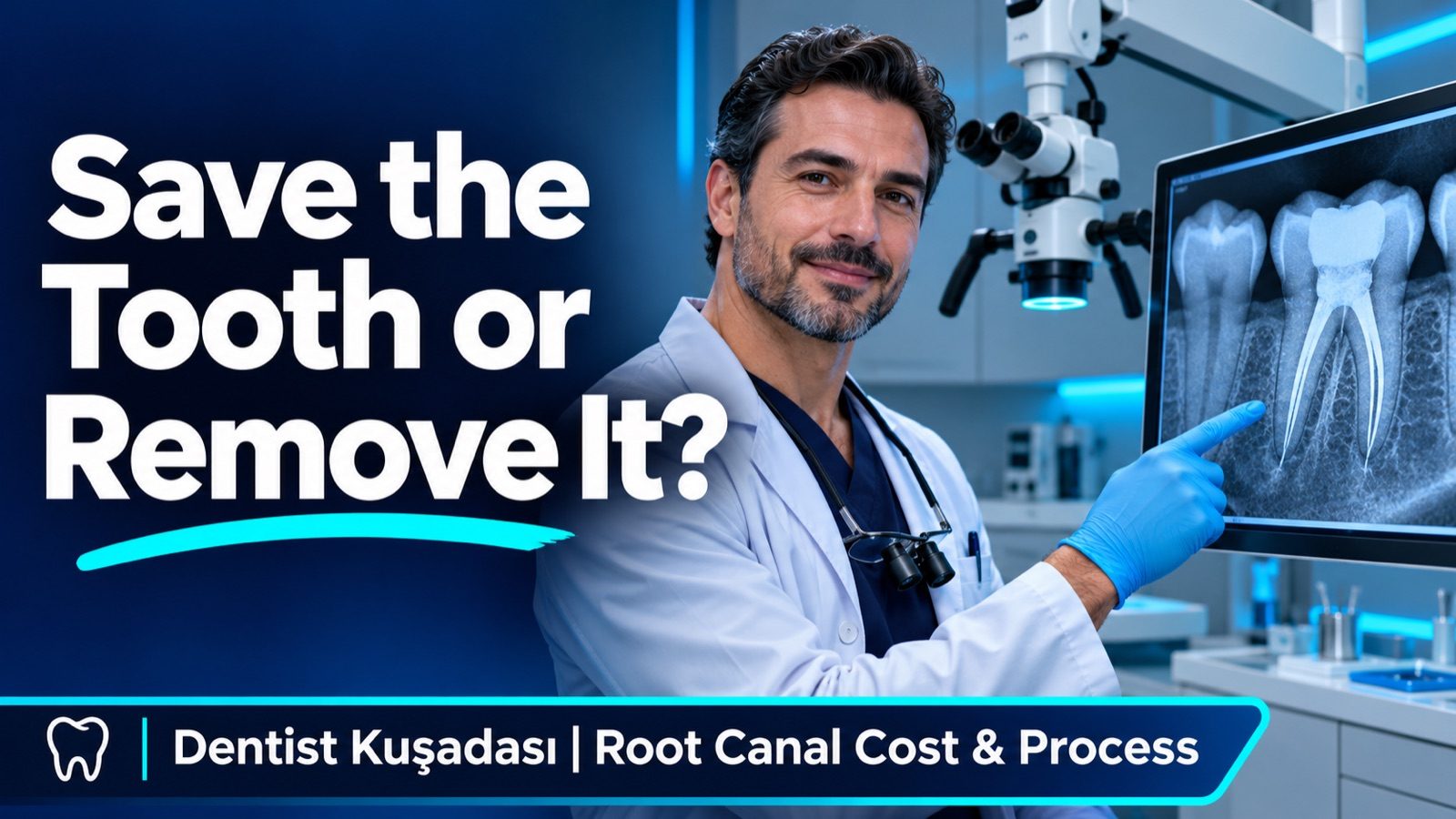
Root canal treatment in Turkey costs between £80 and £350 depending on the tooth, against £300 to £1,500 privately in the UK. It is also the treatment patients most often try to avoid — usually because of a reputation earned decades ago, before rotary instruments and magnification changed what the procedure involves.
When Is a Root Canal Actually Necessary?
A root canal is needed when the pulp — the nerve and blood supply inside the tooth — is irreversibly inflamed or infected. Once that happens the tissue cannot recover, and the two options are to remove it and seal the space, or to remove the whole tooth. There is no third route that leaves an infected pulp in place.
The signs your dentist looks for are lingering sensitivity to heat that persists after the source is removed, pain on biting, a darkening tooth, a gum swelling or sinus tract, and radiographic changes at the root tip. Short sharp sensitivity to cold that disappears immediately is usually not a root canal indication — it is more often a crack, exposed dentine or a failing filling.
Root Canal or Extraction — How Is the Decision Made?
The decision turns on how much sound tooth structure remains, not on how uncomfortable the tooth currently feels. A tooth with enough healthy wall to hold a restoration is usually worth saving; one that has fractured below the gum line generally is not.
| Finding | Usual direction |
|---|---|
| Adequate remaining tooth wall | Save with root canal plus crown |
| Vertical root fracture | Extraction — the tooth cannot be sealed |
| Fracture extending below bone level | Extraction, then implant assessment |
| Severe bone loss around the root | Extraction usually more predictable |
| Previous root canal now failing | Retreatment first, extraction if it fails again |
Saving a natural tooth is generally preferred where the prognosis is reasonable — no implant replicates the ligament that lets a natural tooth sense pressure. But a tooth saved against the odds and lost a year later costs more than an extraction planned properly at the outset.
💬 Have an X-ray from your own dentist? Send it over and our clinicians will tell you whether the tooth looks restorable and what they would plan — free, and honestly if the answer is that it should come out. Get My Free Assessment
How Much Does Root Canal Treatment Cost in Turkey?
Root canal treatment in Turkey costs from £80 for a single-canal front tooth to around £350 for a retreatment on a molar. UK private pricing for the same work typically runs three to five times higher.
| Treatment | Turkey | UK (private) |
|---|---|---|
| Single canal (front tooth) | £80 – £150 | £300 – £600 |
| Multi-canal (premolar / molar) | £120 – £250 | £500 – £1,200 |
| Retreatment of a failed root canal | £180 – £350 | £600 – £1,500 |
| Crown afterwards (zirconium) | From £130 | From £650 |
Figures are 2026 estimates. The number of canals is confirmed radiographically, so a quote given before an X-ray is an estimate rather than a price.
Why Does a Root Canal Usually Need a Crown Afterwards?
A root-treated tooth is more brittle. Removing the pulp also removes the internal moisture and, more importantly, the access cavity plus prior decay leaves the remaining walls thin. Back teeth take heavy biting load, and an uncrowned root-treated molar has a meaningfully higher fracture rate over the following years.
Front teeth with minimal loss are sometimes restored with a bonded filling instead. For molars, a zirconium crown is the usual recommendation. If a quote covers the root canal but omits the crown, the treatment is not finished — ask for both figures together.
Does a Root Canal Hurt?
The procedure itself is carried out under local anaesthetic, and most patients describe pressure and vibration rather than pain. The pain people associate with root canals is usually the infection that brought them in — treatment relieves it rather than causes it.
Tenderness on biting for two to four days afterwards is normal while the ligament around the root settles, and is managed with standard pain relief. Individual experience varies, and a tooth that was acutely infected before treatment tends to be more tender afterwards than one treated electively.
How Many Visits, and How Long in Kuşadası?
Most root canals are completed in one or two appointments over three to four days, with the crown fitted in the same trip. Allow five to seven days in Kuşadası for a root canal plus crown, and longer if several teeth are involved or a retreatment is needed.
Teeth with acute infection are sometimes dressed and left for a period before sealing, which can push the case into two visits. Our appointment process page sets out how the schedule is built around your flight dates.
What Difference Does a Microscope Make?
Magnification lets the clinician see canal openings that are invisible to the naked eye. Missed canals are one of the most common reasons a root canal fails later — an upper molar frequently has a fourth canal that is easy to overlook without magnification.
It also helps in retreatment, where old filling material must be removed and separated instruments or perforations located. When comparing clinics, asking whether endodontics is performed under magnification is a more useful question than asking about the price. The full range is on our root canal treatment page.
Ask us the same question and the answer is yes — endodontic work here is carried out under an operating microscope, and the CBCT scan that shows canal anatomy before treatment begins is part of the assessment rather than an extra. Both are visible on our clinic page.
✈ Not sure whether the tooth can be saved? Book your free online assessment — send your X-ray and get a written plan before you book any flights. Get My Free Quote
Frequently Asked Questions
How much does root canal treatment cost in Turkey in 2026?
Root canal treatment in Turkey costs £80 to £150 for a single-canal front tooth, £120 to £250 for a multi-canal molar, and £180 to £350 for retreatment of a failed root canal. UK private pricing for the same work ranges from £300 to £1,500.
Do I always need a crown after a root canal?
Back teeth almost always do, because a root-treated tooth is more brittle and molars take heavy biting load. Front teeth with minimal structural loss are sometimes restored with a bonded filling instead. Your dentist decides based on how much sound tooth wall remains.
Is it better to have a root canal or an implant?
Where the tooth has enough sound structure and a reasonable prognosis, saving it is generally preferred — no implant reproduces the ligament that lets a natural tooth sense pressure. Where the root is fractured or bone loss is severe, extraction followed by an implant is usually the more predictable route.
How many days do I need in Kuşadası for a root canal?
Allow five to seven days for a root canal with a crown fitted in the same trip. Most root canals are completed in one or two appointments over three to four days, with the remaining time used for the crown. Acutely infected teeth are sometimes dressed first, which can require a second visit.
How long does a root canal last?
A well-sealed root canal restored with an appropriate crown can last many years, and long-term survival is high in published clinical studies. Outcomes vary between individuals and depend on the remaining tooth structure, the quality of the seal, oral hygiene and biting forces.
Can a failed root canal be redone?
Yes. Retreatment involves removing the previous filling material, locating any missed canals, disinfecting and resealing. It is more demanding than a first-time root canal and is where magnification matters most. If retreatment is not viable, extraction and an implant assessment is the alternative.