
 Deutsch
 Nederlands
 Русский
 Türkçe
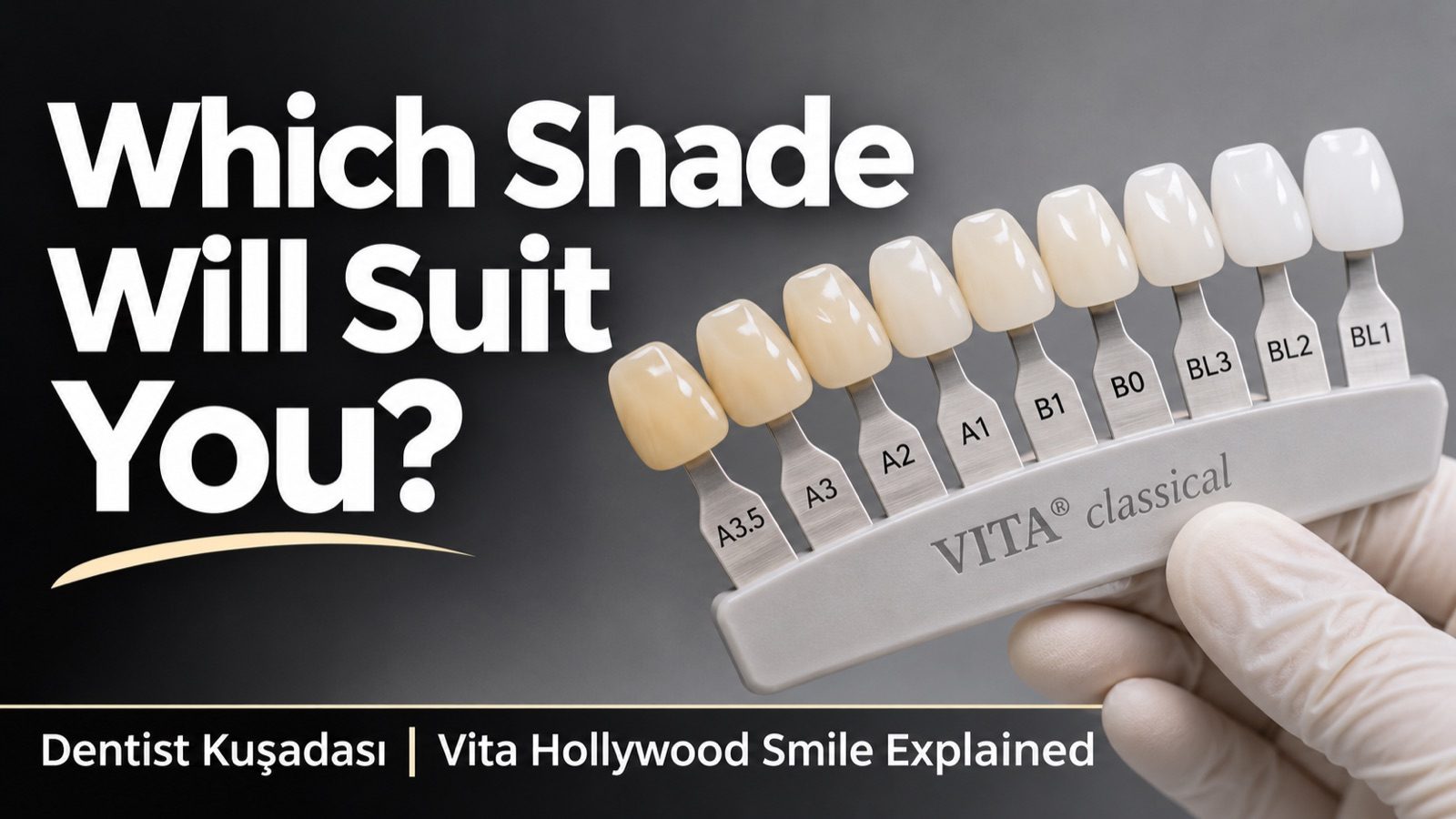
Almost every unnatural-looking veneer case comes down to one decision made in about thirty seconds: the shade. "Vita" is not a brand of veneer — it is the shade system dentists worldwide use to specify colour, and a Vita Hollywood Smile simply means the result was matched against that scale rather than guessed. Which shade you pick from it is the part that determines whether people see your smile or your dentistry.
What Does "Vita" Actually Mean?
Vita is the shade standard used across dentistry to communicate tooth colour precisely between clinic and laboratory. Without it, "a bit whiter" means one thing to you, another to your dentist and a third to the technician who makes the ceramic.
Two systems are in common use. The Vita Classical guide runs A1 to D4, grouped by hue — A is reddish-brown, B reddish-yellow, C grey, D reddish-grey. The Vita 3D-Master system is more precise, separating lightness, chroma and hue so a shade can be specified in three dimensions instead of one letter and a number.
Above the natural range sit the bleach shades — BL1 to BL4 — which are lighter than any shade that occurs naturally in an adult tooth. That is not a criticism; it is simply a fact worth knowing before you choose one.
Which Shade Do Most People Actually Suit?
Most adults suit something between A1 and BL3, and the natural-looking end of a smile makeover usually sits around A1, B1 or BL4. BL1 — the lightest available — is the shade most associated with the look people describe as obvious.
| Shade | Reads as | Typically suits |
|---|---|---|
| A2 – A3 | Natural, unaltered | Patients who want no one to notice anything changed |
| A1 / B1 | Bright but believable | Most smile makeovers — the common recommendation |
| BL3 – BL4 | Noticeably light, still plausible | Younger patients, fair skin, full-arch cases |
| BL1 – BL2 | Clearly cosmetic | Deliberate high-contrast look, on camera |
Three things shift the answer: skin tone (deeper tones carry lighter shades more comfortably), age (a very light shade reads as artificial against mature facial features), and the whites of your eyes — teeth lighter than your sclera almost always look wrong.
💬 Not sure where on the scale you belong? Send a smiling photo taken in daylight without a filter, and our clinicians will tell you which shade range they would recommend for your colouring — and which they would talk you out of. Get My Free Assessment
Why Does Shade Choice Cause the "Turkey Teeth" Look?
The look people criticise is rarely about the country and almost always about two decisions taken together: a bleach shade at the top of the scale, and ceramic with too little translucency. Either alone can pass. Combined, they produce a uniform opaque band that reads as a single object rather than as individual teeth.
Natural teeth are not one colour. They are darker at the neck, lighter at the tip, and slightly translucent at the edge where light passes through. A well-made veneer reproduces that gradient. A cheap one is a flat slab of a single shade, and no amount of choosing the "right" number on the guide fixes it.
This is why the material and the laboratory matter as much as the shade code. The layering that creates translucency is skilled handwork, not a setting.
How Is the Shade Chosen Properly?
Shade is taken in natural daylight, early in the appointment before the eyes fatigue, against a neutral background and with strong lipstick removed. It is checked against the whites of the eyes and the skin, not held up in isolation.
- Whitening first if natural teeth will remain visible beside the veneers, then two weeks for the shade to settle.
- Shade taken in daylight, cross-checked with a second opinion from the technician where possible.
- Digital design and a try-in stage — seen in your own mouth, in your own face, before anything is bonded.
- Adjustment at try-in if it reads differently in life than it did on the guide.
That try-in stage is the safeguard. If a treatment plan goes from preparation straight to final bonding with no opportunity to look in a mirror and change your mind, the shade decision is being made without you.
Can the Shade Be Changed Afterwards?
Not by whitening — ceramic does not respond to bleaching gel at all. Once veneers are bonded, changing the colour means remaking them, which is a full repeat of the laboratory work and the cost.
This is the practical reason to resist the brightest option. Choosing a shade slightly more conservative than your instinct leaves room to be pleased; choosing the lightest available leaves nowhere to go if it reads as too much in ordinary daylight. Full details of the material and shade options are on our Vita Hollywood Smile page.
Does Shade Affect Price?
The shade code itself does not. What affects price is the ceramic and the layering — a multi-layered lithium disilicate veneer that reproduces natural translucency costs more in laboratory time than a monolithic one pressed in a single shade.
When comparing quotes, ask which material is used and whether the veneers are layered or monolithic. Two identical shade codes can produce very different results. You can see how this plays out across our laminate veneers and Hollywood Smile options.
There is a practical reason shade goes wrong less often when the technician is in the building. They can look at your face in daylight rather than working from a written code, come to the chair at the try-in, and adjust before anything is bonded. A shade code posted to an external laboratory is a description; a technician standing next to you is a correction.
✈ Want to see your shade before anything is permanent? Ask us about the digital design and try-in stage when you book your free assessment. Get My Free Quote
Frequently Asked Questions
What is a Vita Hollywood Smile?
Vita is the international shade system dentists use to specify tooth colour precisely between clinic and laboratory. A Vita Hollywood Smile means the veneer shade was matched against that standard scale rather than estimated, so the result is reproducible and can be communicated exactly to the technician.
Which Vita shade looks the most natural?
A1 and B1 are the shades most commonly recommended for a bright but believable result. A2 to A3 reads as completely unaltered. The bleach shades BL1 and BL2 are lighter than any naturally occurring adult tooth and read as clearly cosmetic.
Why do some veneers look fake?
Usually two decisions combined: a bleach shade at the top of the scale, and ceramic with too little translucency. Natural teeth vary in colour from neck to tip and let light through at the edge. A flat single-shade veneer reproduces neither, so the teeth read as one object rather than as individual teeth.
Can veneer shade be changed after they are fitted?
No. Ceramic does not respond to whitening gel, so changing the colour means remaking the veneers entirely, at full laboratory cost. This is why choosing a slightly more conservative shade than your first instinct is the safer decision.
How is veneer shade chosen correctly?
In natural daylight, early in the appointment before the eyes fatigue, against a neutral background and with strong lipstick removed. It is cross-checked against the whites of your eyes and your skin tone, then confirmed at a try-in stage where you see the veneers in your own mouth before anything is bonded.